What started as a simple Slack workspace for sharing memes and quick messages has evolved into the central nervous system of our household. At the heart of this transformation is Jeeno - our personal AI assistant built with OpenClaw, named after the robo dog from Sujatha's famous sci-fi novel Meendum Jeeno. In the book, Jeeno is a self-learning robotic companion, and our version embodies that spirit with its own self-learning capabilities, adapting to our family's needs over time. This isn't just a chatbot—it's a proactive, memory-equipped system that anticipates needs, organizes our lives, and feels like a natural extension of our family. Here's how we built our very own "Home OS."
Selecting the Foundation: Slack as the Core Platform
We opted for Slack over platforms like WhatsApp due to its inherent organizational features: themed channels, built-in workflows, and reminder capabilities, which our family was already accustomed to using. Integrating OpenClaw elevated it from a mere messaging tool to an autonomous system, where interactions serve as the primary interface for household operations.
Channel Architecture: Evolution and Specialization
Before Jeeno's integration, our channels were functional yet compartmentalized:
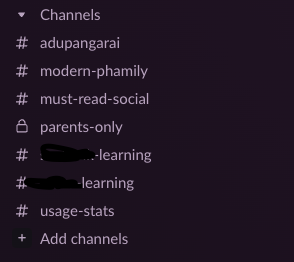
- #Adupangarai (translating to "kitchen" in our native language): Focused on culinary discussions.
- #must-read-social: of course, the Insta reels and some articles we want to bookmark and read later.
- #modern-phamily: The primary family forum for general coordination and sharing.
- Two dedicated learning channels, one per child: Used for monitoring homework, class schedules, and assignment deadlines.
- #parents-only: A private channel for confidential parental deliberations.
To optimize performance, we deployed specialized sub-agents. Following integration, we introduced new
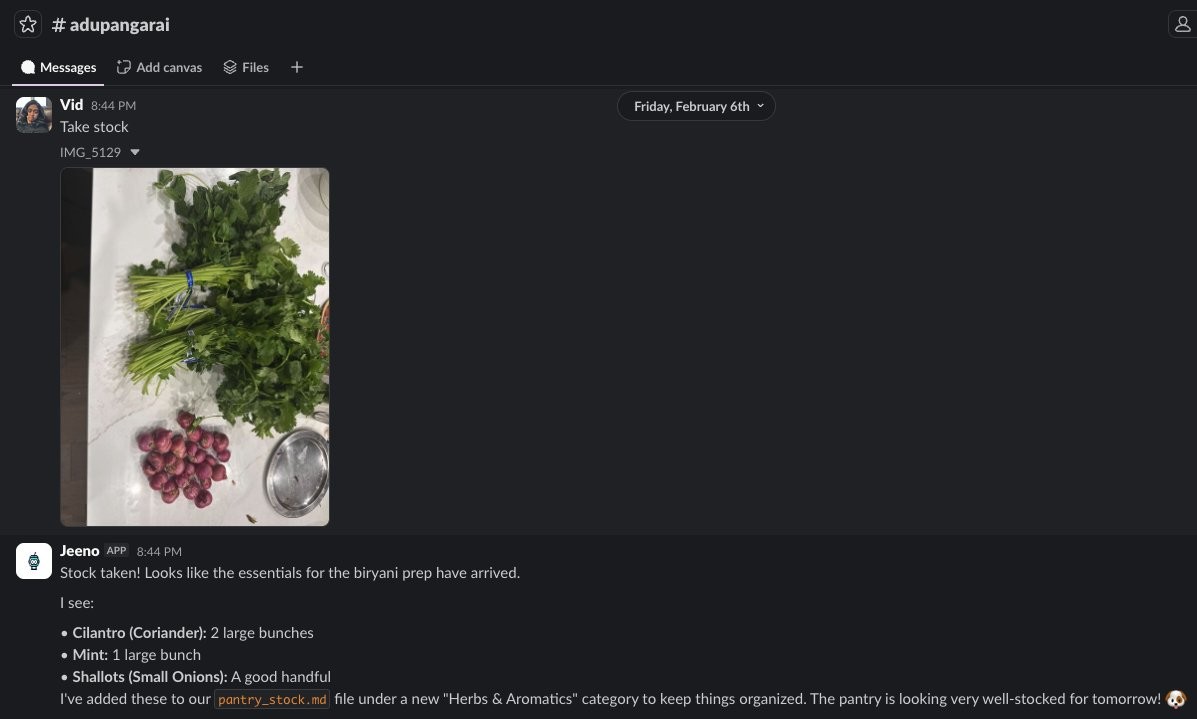
- Nalan in Adupangarai manages pantry inventory through image uploads and generates meal plans based on available resources.
- Madam-Hooch and Labubu: Serve as academic coaches in the respective children's learning channels, emphasizing guidance and curiosity over rote assistance. The high-schooler's coach (Madam Hooch - yes, we are Potterheads) is a bit more tailor-made.
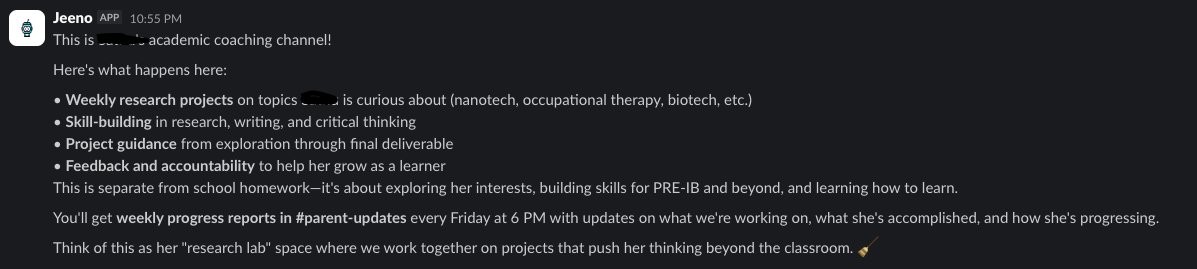
- The main jeeno agent oversees parents-only, automating calendar entries and venue recommendations while preserving privacy.
Advancing to Proactive Functionality
The introduction of scheduled cron jobs marked a significant enhancement. Jeeno now delivers daily direct messages with innovative activity suggestions, such as educational experiments or local outings, to foster family engagement from the outset of the day. Additionally, it analyzes conversation trends across channels and provides weekly summaries, for example, recommending nearby hiking trails based on discussions about outdoor pursuits. This transition rendered Slack a dynamic environment, converting unstructured dialogues into actionable insights and establishing chat as a proactive operating layer.
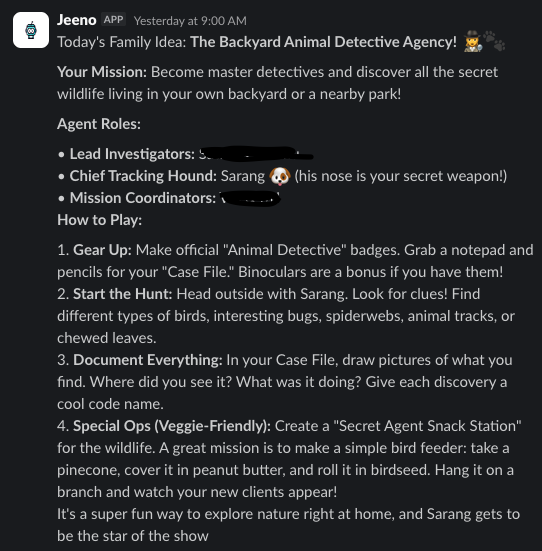
The above screenshot is a great example, as it came up with this idea for the weekend and took into consideration that the younger one had a science project due on bugs and birds, and we were discussing giving our dog a walk so that he could sniff his heart out!
Customizing Personality and Guidelines
Jeeno's distinctiveness stems from its configurable personality, defined in files such as for soul.md for fundamental traits and user.md for user-specific directives. Such tailoring ensures the system aligns with family dynamics, enhancing adoption and effectiveness. We even gave it some Vadivelu (Tamil comedian) like personality! (Next step is to teach it some of gif way of communication)
Iterative Refinement: Key Patterns in Development
Our development process revealed recurring strategies essential to creating a robust system.
System Administration: Optimizing Performance
We actively manage Jeeno's infrastructure, querying usage statistics and reallocating tasks from resource-intensive models like Opus to cost-effective alternatives like Sonnet. Automated workflows, including an "archivist" for summarization and a "janitor" for purging at a 50% compaction threshold, promote efficiency and longevity.
Implementing Persistent Memory and Context Management.
A common limitation of chat applications is the ephemeral nature of discussions. To address this, Jeeno incorporates a file for storing enduring details, such as dietary preferences, ensuring personalized and consistent responses.
Daily interaction logs are maintained, supplemented by a nightly cron job that summarizes concluding sessions to retain context without manual intervention.
Notably, this system enables cross-channel memory sharing, creating an interconnected knowledge base that enhances overall utility—much like a file system in a traditional OS. We were also able to configure what gets shared across channels.
Following is a great example: We had mentioned in another channel about a get-together at home, and earlier that week, we mentioned what would be on the menu.
Model Optimization: Achieving Balance
A core challenge involved selecting appropriate models, balancing capability, cost, and speed. Initial overuse of high-end models for routine tasks led to adjustments favoring a multi-model approach: Advanced models for interactive sessions and efficient ones for background processes, mitigating issues like API rate limits and breaking our banks for some fun experiments. Our main models - Anthropic Sonnet 4.5, Opus 4.5, Gemini 2.5 pro. We also configured fallback models - Kimi Moonshot and MiniMax.
Technical Infrastructure: Secure and Scalable
Hosted locally on a Mac Mini, the system prioritizes privacy with no external data transmission. And the only allowed channel is Slack, and the tool sets are extremely limited (a brave api for browser search, separate email for the bot, no access to passwords or other emails, separate Mac user context, dockerized for isolation, limited folder access).
Looking Forward: An Ongoing Journey in Chat-Centric Automation
Our journey with Jeeno and Openclaw represents just the beginning of exploring chat as a foundational operating system for the home. As we continue to refine and expand its capabilities, we are eager to incorporate additional automations—such as advanced health tracking, personalized fitness routines, or integrated financial planning—to further streamline our daily lives. And we want to continue to keep the data local in our own systems. And possibly even build our own internal family knowledge base! 🙂( A legacy to pass on) Next stop: Exploring GraphRAGs, vectorDBs, compound engineering...
Originally published on LinkedIn.